
ca. 2 Tage Lieferzeit
Nanocrystals:
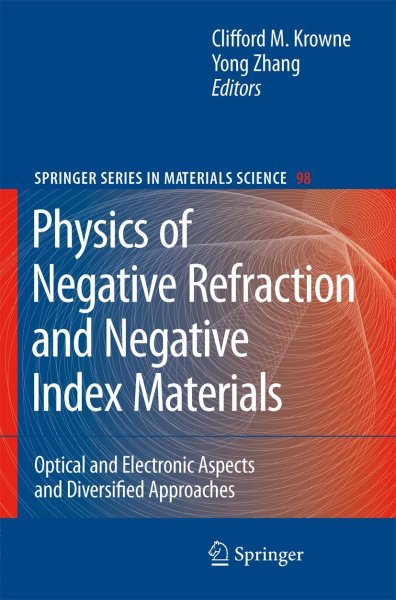
Physics of Negative Refraction and Negative Index Materials
Laser Ablation
Organic Photovoltaics
Effective Electron Mass in Low-Dimensional Semiconductors
Nanocrystalline Ceramics
Atomistic Properties of Solids
Multifunctional Barriers for Flexible Structure
Extended Defects in Germanium
Optical Properties of Metal Clusters
und weitere (insgesamt 137)
There are many potentially interesting phenomena that can be obtained with wave refraction in the "wrong" direction, what is commonly now referred to as negative refraction. All sorts of physically new operations and devices come to mind, such as new beam controlling components, re?ectionless interfaces, ?at lenses, higher quality lens or "super lenses," reversal of lenses action, new imaging components, redistribution of energy density in guided wave components, to name only a few of the possibilities. Negative index materials are generally, but not always associated with negative refracting materials, and have the added property of having the projection of the power ?ow or Poynting vector opposite to that of the propagation vector. This attribute enables the localized wave behavior on a subwavelength scale, not only inside lensesandinthenear?eldoutsideofthem,butalsoinprincipleinthefar?eld of them, to have ?eld reconstruction and localized enhancement, something not readily found in ordinary matter, referred to as positive index materials. Often investigators have had to create, even when using positive index materials, interfaces based upon macroscopic or microscopic layers, or even heterostructure layers of materials, to obtain the ?eld behavior they are se- ing. For obtaining negative indices of refraction, microscopic inclusions in a host matrix material have been used anywhere from the photonic crystal regime all the way into the metamaterial regime.
ca. 2 Tage Lieferzeit
ca. 2 Tage Lieferzeit
ca. 2 Tage Lieferzeit
ca. 2 Tage Lieferzeit
ca. 2 Tage Lieferzeit
ca. 2 Tage Lieferzeit
ca. 2 Tage Lieferzeit
ca. 2 Tage Lieferzeit